Jujutsu Kaisen. Yuji Itadori and Sukuna share one body, but they do not share one voice. In Japanese, you can often tell almost immediately which one of them is speaking.
Beyond Translation is about the layer of Japanese manga that a Japanese reader picks up without thinking — and what an English reader might not have the context to pick up.
English already gives you a Sukuna who is dangerous, confident, and dominant. He gives orders, he threatens people, he talks as if everyone else is already below him. The basic character reading works. This is not a “the translation got Sukuna wrong” video, and I’m not going to pretend otherwise.
What Japanese adds on top of that same reading isn’t more menace. It’s texture. And it is subtler than the exaggerated archaic voice you might expect from an ancient King of Curses — his first-person pronoun is just “ore,” and his Japanese is easy for a modern reader to understand.
In chapter eight he says “yoi, yoi.” In everyday speech, “ii, ii” would keep the basic meaning; the National Institute for Japanese Language and Linguistics describes “ii” as the colloquial form of “yoi.” So by comparison, “yoi” feels a little less conversational. Nothing dramatic has happened to the meaning. The texture of the voice has changed.
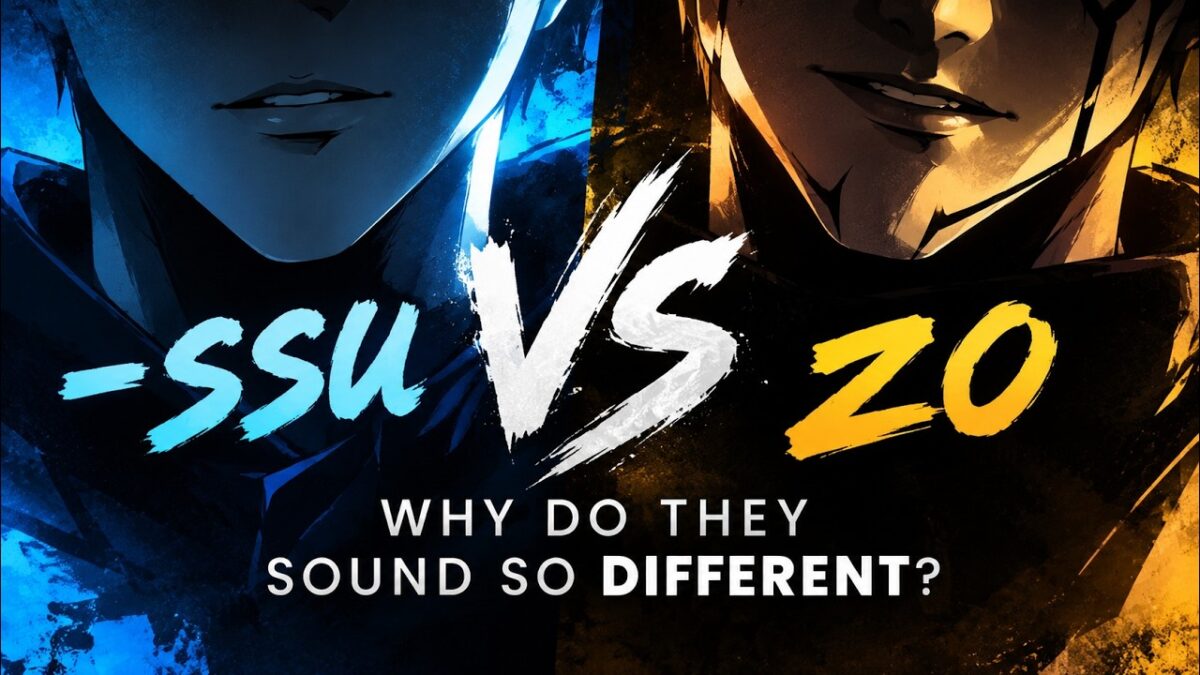
Around chapters seven and eight he keeps ending sentences with “zo” — “nakama ga shinu zo,” “modoran zo,” “moratte iku zo.” The Shogakukan dictionary describes sentence-final “zo” as strongly addressing the listener. These lines don’t simply stop. They land outward, toward someone. And he keeps choosing that ending.
Then there’s a line where he says “ii kikai da. oshiete yaru. honmono no jujutsu to iu mono o.” Roughly: this is a good opportunity, I’ll teach you what real jujutsu is. He puts himself in the role of the person who teaches, and he isn’t offering one possible reading of jujutsu — he calls it “honmono,” the real thing. He speaks from the position of someone who gets to define the standard.
Whether the author built any of this deliberately, I don’t know. But vocabulary, sentence ending, and positioning are three different parts of the language, and they point the same way.
And this is where Yuji matters. “ssu.” “nna koto.” “sasenee yo.” Those choices already make him sound like a contemporary teenager. Put Sukuna beside that already-light voice and the weight becomes much clearer. The contrast doesn’t create Yuji’s lightness — it makes Sukuna’s weight easier to hear.
0:00 One body, two voices
0:33 What the English version already gives you
1:19 The first layer: how conversational a word feels
1:57 The second layer: how a sentence lands
2:28 The third layer: who gets to define “the real thing”
3:03 Three parts pointing the same direction
3:24 Yuji’s already-light voice
3:51 What I wanted to show
If you don’t read Japanese, you don’t need to memorize “yoi” or “zo.” The useful part is the pattern: a character voice can live in how conversational a word feels, how a sentence lands, and where the speaker places himself relative to someone else.
Did Sukuna read as heavy to you in English too?
That’s Beyond Translation.
I write longer pieces on this kind of detail here:
https://beyondtranslation.substack.com
Read JUJUTSU KAISEN officially on MANGA Plus by SHUEISHA.
Independent commentary and analysis. Not affiliated with or endorsed by SHUEISHA, the author, or the official English publisher. Japanese lines are quoted from the original; the English renderings here are mine, not official translations.
#JujutsuKaisen #Sukuna #BeyondTranslation #JapaneseLanguage #MangaAnalysis